Ahead of The Rupture
PULSE Issue 46 | Jan 2026
NUHCS introduces a personalised preventive treatment for aortic patients - a first in Southeast Asia.
An aortic aneurysm is often called a silent killer. It grows quietly, without any symptoms or warning signs, but when the weakened wall of the aorta - the body's largest artery - suddenly tears or bursts, the results can be catastrophic. Each year, this condition causes 150,000 to 200,000 deaths worldwide, with nearly 80% of ruptures proving fatal1.
What if it were possible to stop the aneurysm before it ruptures?
A new surgical procedure called Personalised External Aortic Root Support (PEARS) offers a preventive option for patients at risk of an aortic rupture.
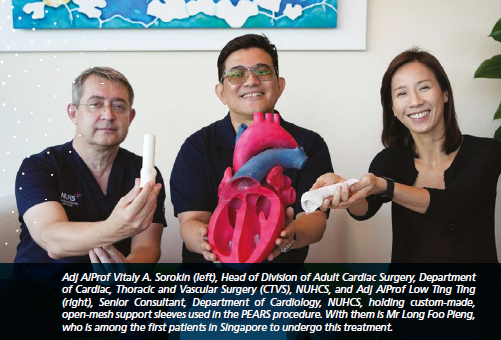
The treatment reinforces the aorta early before it becomes severely enlarged, by using 3D printing and a customised external mesh sleeve that provides long-term support. At the National University Heart Centre, Singapore (NUHCS), the first PEARS procedure in Southeast Asia was performed by Adj A/Prof Vitaly A. Sorokin, Head, Division of Adult Cardiac Surgery, Department of CTVS, NUHCS.
Understanding Aortic Aneurysms
The aortia carries oxygen-rich blood from the heart to the rest of the body. When part of its wall weakens and bulges, an aneurysm forms. Causes include genetic conditions (such as Marfan syndrome2), high blood pressure, valve disorders, or age-related degeneration.
Many aneurysms remain undetected until they reach a dangerous size. At NUHCS, around 300 patients with aortic aneurysms are seen each year, with nearly 30 requiring emergency surgery for an impending rupture.
Traditionally, patients with large or rapidly growing aneurysms undergo aortic root replacement - a major operation involving a heart-lung bypass and replacement of the affected section with a synthetic graft. While lifesaving, this is a complex and high-risk surgery.
The PEARS Procedure
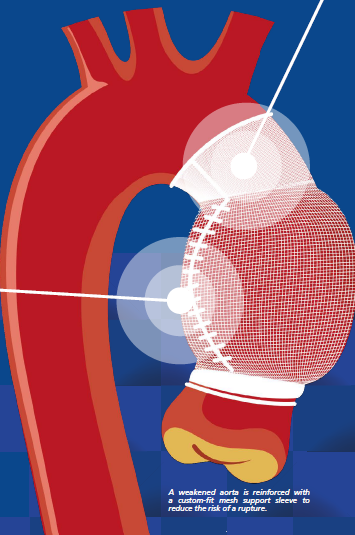
PEARS provides an alternative, proactive approach for selected patients whose aortas are mildly enlarged. Instead of replacing part of the aorta, surgeons place a customised, open-mesh sleeve around the aorta. This sleeve acts like a supportive "glove", stabilising the aorta and preventing further dilation.
What makes the treatment unique is its personalisation. A Computed Tomography (CT) scan of the patient's heart and aorta is used to create 3D-printed model, which serves as a mould for crafting the custom-fit mesh sleeves. This ensure the sleeve conforms precisely to the patient's anatomy, providing long-term reinforcement and reducing the risk of rupture.
Compared with conventional aortic root replacement, PEARS is less invesive, preserves the patient's pwn aortic tissue, and reduces operating time by half, thus lowering surgical risk and supporting faster recovery.
A Swift Return to Everyday Life
Since late 2024, six patients at NUHCS have successfully undergone the PEARS procedure. One of them, Mr Long Foo Pieng, 56, was diagnosed with a congenital bicuspid aortic valve3 condition that caused progressive dilation of his aorta. He underwent PEARS in 2024 and was discharged within a week. Six months later, he resumed his regular activities.
"I was very happy (to be) back at the golf course again, going to the driving range almost two or three times a week like I used to," said Mr Long.
More That Just Prevention
While PEARS is suitable only for selected patients, it represents an important advancement in the management of aortic aneurysm. By Intervening early and preserving the patient's own anatomy, it helps patients avoid complex major surgery in the future and live life fully, without the constant fear of rupture.

As the technology and expertise continue to evolve, PEARS is poised to change not only how doctors treat aortic aneurysms - but how patients experience life after diagnosis.
References:1. Cho, M.J., Lee, MR. & Park, JG. Aortic aneurysms: current pathogenesis and therapeutic targets. Exp Mol Med 55, 2519–2530 (2023). https://doi.org/10.1038/s12276-023-01130-w
2. Marfan syndrome is a genetic disorder that affects the body’s connective tissue and can weaken the aorta’s walls.
3. A bicuspid aortic valve is a heart valve with only two leaflets instead of the usual three.