Bridging Care Across The Community
Connecting specialists and primary care doctors for a smoother patient journey
PULSE Issue 46 | Jan 2026
As cardiovascular care becomes increasingly complex, seamless coordination between cardiac specialists and primary care providers1 is more critical than ever. Keeping pace with advancements in cardiovascular medicine is essential to delivering high-quality patient care. The National University Heart Centre, Singapore (NUHCS) is strengthening this foundation by integrating specialist knowledge directly into primary care – ensuring General Practitioners (GPs), polyclinic doctors and nurses have real-time support and resources.
The Foundation: Continuous Professional Growth
At the core of this strategy is Continuing Medical Education (CME). These structured learning sessions are designed to help doctors consistently update their clinical knowledge, sharpen their skills, and stay current with the latest guidelines mandated by the Singapore Medical Council.
NUHCS as a national centre for the treatment of cardiovascular diseases also stands at the forefront of education, designing its CME sessions for primary care partners to receive the latest insights and practical know-hows when dealing with common cardiac situations. From learning how to accurately interpret Electrocardiograms (ECGs)2 to managing conditions such as venous disorders3, and receiving insights on updated treatment protocols, primary care teams are empowered to make informed decisions that directly improve patient outcomes.
These sessions also foster closer collaboration between specialists and primary care providers, creating a direct communication channel where primary care providers can clarify questions and discuss case studies with NUHCS cardiovascular specialists, building confidence in identifying when patients require specialised hospital referral.

The Community Cardiology Team
Building on these collaborative efforts, the Community Cardiology team was established in 2022 to anchor cardiology care within the community and strengthen coordination with primary care colleagues. Since its inception, the team has introduced initiatives such as the NUHCS Shared Care programme for stable ischemic heart disease4 and heart failure patients. This programme enables co-management between cardiac specialists and primary care teams, ensuring patients receive continuous and coordinated care.
What is the NUHCS Shared Care Programme?
The NUHCS Shared Care Programme supports patients with stable heart conditions by enabling coordinated care between NUHCS cardiologists and primary care doctors in the community. Through regular follow-ups with a trusted primary care provider and scheduled specialist reviews, patients receive high-quality, continuous care closer to home, making follow-up support more convenient without compromising safety.

Consulting Specialists in Seconds
Beyond Shared Care programmes, the Community Cardiology team introduced the Virtual Professional Care (VPC) chat groups. The VPC allows primary care doctors to obtain rapid expert opinions on complex cardiology queries, supporting timely and well-informed clinical decisions. It also serves as a channel for sharing educational updates and publicising upcoming events, further strengthening links between general practice and specialist care.
Learning on the Go
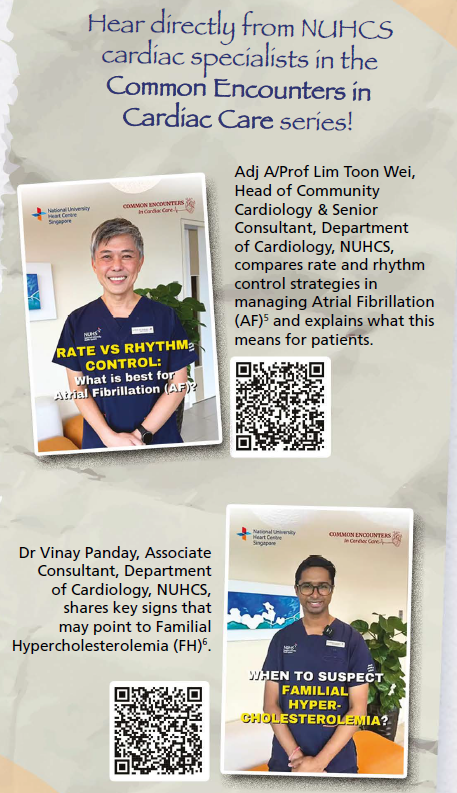
Recognising the challenges of a busy clinic schedule, the Community Cardiology team also conceptualised the Common Encounters in Cardiac Care video series for primary care providers. These bite-sized educational videos covering relevant cardiology topics help doctors better understand and manage common heart-related conditions encountered in their everyday practice.
Primary care providers have responded positively to the series, valuing its concise, practical, and easy-to-follow format. Many find the videos particularly helpful for navigating common cardiology scenarios and applying actionable tips in their day-to-day work.
Through these combined efforts – structured education, specialist collaboration, and accessible digital learning – NUHCS remains committed to supporting primary care providers in delivering high-quality cardiovascular care. These integrative approaches ensure that advances in cardiology are translated meaningfully into everyday practice, leading to more timely and better patient outcomes across the care continuum.
References:
1. Primary Care Provider (PCP): a doctor or other licensed medical professional, such as a nurse practitioner or physician assistant, who manages a person’s health care over time.
2. Electrocardiogram (ECG): a recording of the heart's electrical activity.
3. Venous Disorders: valve or blood vessel abnormalities.
4. Stable Ischemic Heart Disease (SIHD): a chronic condition where the heart muscle does not get enough oxygen-rich blood, causing symptoms like chest pain, shortness of breath, and fatigue.
5. Atrial Fibrillation (AF): the most common heart rhythm disorder where the heart's upper chambers quiver chaotically instead of beating effectively, causing an irregular heartbeat, poor blood flow, and increased risk of blood clots, stroke, and heart failure.
6. Familial Hypercholesterolemia (FH): an inherited genetic condition that causes very high levels of "bad" cholesterol (LDL) from birth, significantly increasing the risk of heart disease.