Bringing Cardiac Care Beyond Borders
NUHCS at the ESC Congress 2025
PULSE Issue 46 | January 2026
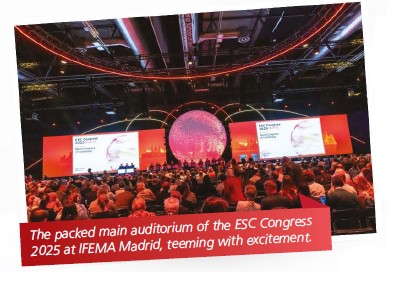 The world of cardiovascular medicine came alive once again at the European Society of Cardiology (ESC) Congress 2025 – the largest global gathering of heart specialists and researchers. Held from 29 August to 1 September 2025 at the impressive IFEMA in Madrid, the congress marked the 75th anniversary of ESC, drawing more than 33,000 participants and 6390 presenters from 169 countries under the theme of “Global Health: Cardiology Beyond Borders”.
Highlights of Scientific Research Presentation
This year’s congress was a showcase of scientific breakthroughs, with over 190 simultaneous publications and 10 Hot Line plus 42 Late-Breaking Science sessions, revealing findings that could redefine cardiovascular care.
Redefining Cardiovascular Risk Control
In line with the congress theme, emerging therapies for lipid (cholesterol) lowering and resistant hypertension took the spotlight. The ESSENCE CS9 TIMI 73b and BaxHTN trials introduced new approaches to managing these key cardiovascular factors.
Challenging existing treatment standards
Long-held practices were re-examined with new evidence. The REBOOT-CNIC and BETAMI-DANBLOCK trials (published in the New England Journal of Medicine) presented mixed results on the benefits of beta-blockers for post-myocardial infarction (heart attack) patients with heart function [Left Ventricular Ejection Fraction (LVEF)] of at least 40%. Meanwhile, the DAPA ACT HF-TIMI 68 trial (published in Circulation1) remained the safety of starting Sodium-Glucose coTransporter-2 (SGLT-2) in-hospital inhibitors2.
Revisiting anti-platelet therapy patients after a heart attack
Studies such as the NEO-MINDSET, TARGET-FIRST and DUAL-ACS trials highlighted the potential feasibility of shortening the duration of Dual Anti-Platelet Therapy (DAPT)3 for patients after a heart attack. A Lancet meta-analysis also found clopidogrel monotherapy to be just as safe as aspirin.
Advances in Hypertrophic Cardiomyopathy (HCM)4
In the field of HCM, MAPLE-HCM trial (NEJM) showed Aficamten monotherapy to be superior to Metoprolol monotherapy, whilst the ODYSSEY-HCM trial (NEJM) reported the lack of benefit of Mavacamten in non-obstructive HCM.
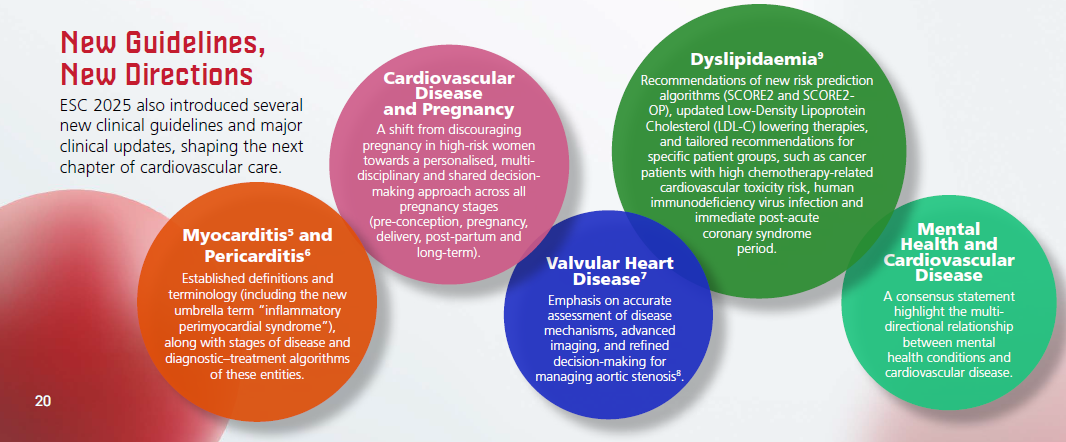
Leading in Strength and Science
The growing contingent representing National University Heart Centre, 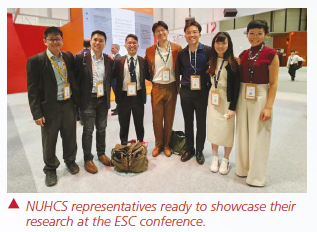
Singapore (NUHCS), once again made a strong impact at the ESC Congress 2025. Building on last year’s achievements, the team led by
Adj A/Prof William Kong, Senior Consultant, Department of Cardiology,
NUHCS, Dr Sia Ching Hui, Consultant, Department of Cardiology, NUHCS,and Dr Benjamin Tung, Consultant, Department of Cardiology, NUHCS, co-authored over 25 abstracts and delivered 14 presentations, showcasing groundbreaking research that advances cardiovascular science and patient care.
NUHCS experts were also featured prominently in discussions and panels. Dr Sia Ching Hui joined renowned global
expert Prof Greg Lip in a session on Atrial Fibrillation10 management, while Adj A/Prof William Kong, Dr Sia Ching Hui and Dr Sim Hui Wen from the Department of Cardiology, NUHCS, served as faulty moderators for various abstract and
poster sessions – reflecting NUHCS’ growing international recognition in cardiovascular research and care.
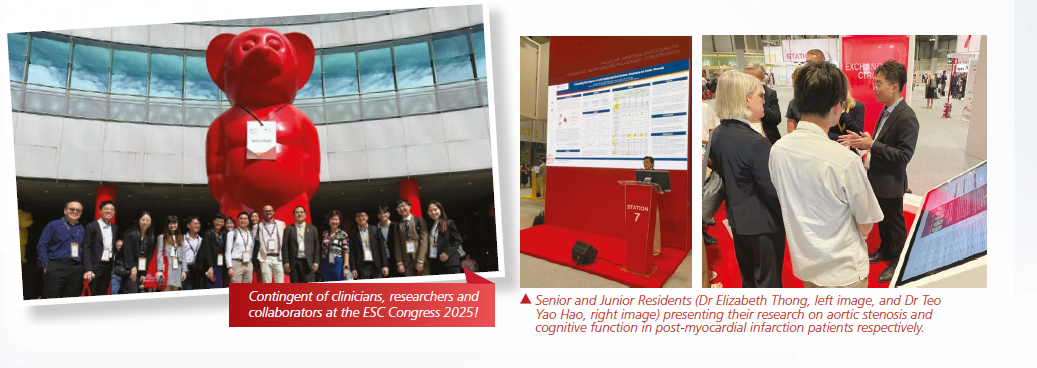
Milestones and Renewed Inspiration
This year’s congress held special significance as Dr Sia Ching Hui was 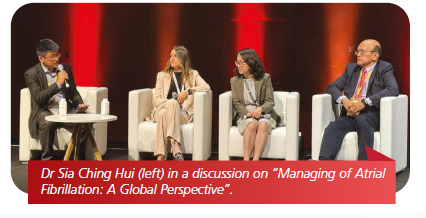 conferred the title of Fellow of the European Society of Cardiology (FESC) – a proud moment for NUHCS.
After four inspiring days in Madrid, the NUHCS team returned energised and grateful, ready to channel the same passion and momentum from the global stage into advancing patient care at home.
References:
- Circulation – One of the world’s top peer-reviewed scientific journal publicationsin cardiovascular research, by the American Heart Association (AHA).
- SGLT-2 inhibitors – Medications that block proteins in the kidneys fromreabsorbing glucose from the urine back into the bloodstream.
- Dual Anti-Platelet Therapy (DAPT) – A treatment using two types of bloodthinningmedications to stop platelets from forming clots.
- Hypertrophic Cardiomyopathy (HCM) – A condition where the heart musclebecomes abnormally thick, making it harder for the heart to pump bloodproperly.
- Myocarditis – A condition where the heart muscle becomes inflamed, typicallyfrom infections or viruses, making it harder for the heart to pump blood properly.
- Pericarditis – A condition where the outer sac lining of the heart is inflamed,typically from viral infections or post-heart attacks, causing friction and pressurearound the heart.
- Valvular Heart Disease – A condition where one or more of the heart’s valves aredamaged and/or loses function.
- Aortic Stenosis – A condition where aortic valves in the heart becomes narrowed,making it harder for blood to flow.
- Dyslipidaemia – Abnormal levels of fats (lipids) in the blood, posing a risk factorfor cardiovascular disease.
- Atrial Fibrillation – A heart rhythm disorder where the heart’s upper chambersbeat irregularly and often very rapidly.