Over 20 Years of Cardiology Expertise in One Book
Launch of the Case-based Comprehensive Cardiology Book
PULSE Issue 47 | July 2026
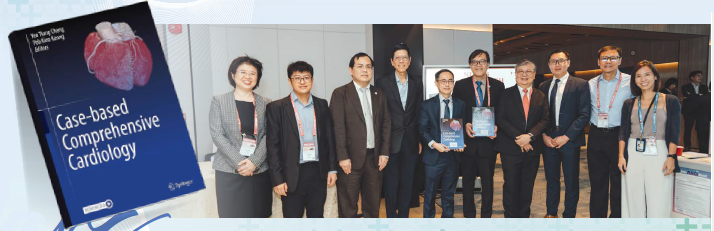
The National University Heart Centre, Singapore (NUHCS) has launched a new cardiology textbook that transforms more than two decades of clinical experience into a practical, case-based learning resource for doctors.
Titled Case-based Comprehensive Cardiology, the book reflects a shared effort to bring real-world clinical insights into medical education, helping healthcare professionals learn not only from theory, but from the complexity of real patient cases.
The launch took place on 22 May 2026 at the 19th Asian Society of Cardiovascular Imaging (ASCI) 2026 conference in Singapore, a regional gathering of cardiovascular imaging specialists focused on the latest advances in the field. The event was officiated by Guest-of-Honour, Prof Tan Chorh Chuan, Permanent Secretary, National Research & Development, and S&T Policy & Plans Office.
Authored by NUHCS cardiologists Prof Yeo Tiong Cheng, Group Chief of Cardiology and Senior Consultant, NUHCS,
and Prof Poh Kian Keong, Senior Consultant, Department of Cardiology, NUHCS, the textbook represents their collective expertise — with contributions from cardiologists and radiologists across NUHCS and National University Hospital — condensed into an immersive, interactive learning experience. Built around real-world cases and dynamic imaging videos, this new publication endeavor brings cardiology practice to life beyond the page.
Instead of traditional textbook chapters that focuses mainly on theory, Case-based Comprehensive Cardiology is built
with clinical questions that guide readers through the diagnostic process with clear explanations, evidence-based answers and practical discussions. This creates an immersive and comprehensible learning experience needed to manage a wide range of cardiac conditions in everyday practice.
Modern imaging plays a central role throughout the book. Actual images from Computerised Tomography (CT) coronary angiography1 and cardiac Magnetic Resonance Imaging (MRI)2 are integrated as interactive video formats into the case analysis, helping readers visualise first-hand and understand how these tools inform diagnosis and guide treatment decisions. Through a simple scan of a QR code found next to each clinical case analysis, readers can easily access the diagnostic imaging footage to practise and apply their clinical knowledge.
The book covers a broad spectrum of cardiovascular conditions, ranging from common diseases such as coronary artery disease3 and valvular disorders4 to more complex conditions including cardiomyopathies5, congenital heart disease6, and rhythm disorders. Designed for doctors in training and healthcare professionals across different specialties, it serves as a practical guide that complements hands-on clinical experience with evidence-based insights.
Beyond the textbook itself, Case-based Comprehensive Cardiology reflects a broader commitment to advancing cardiovascular education and supporting the next generation of heart specialists. By translating decades of clinical experience into structured, case-based learning, the book helps equip healthcare professionals with the knowledge and confidence to deliver high-quality, patient-centered cardiac care.

References:
1. Computerised Tomography (CT) coronary angiography – A scan that uses X-rays to create detailed images of the heart’s blood vessels to check for blockages or narrowed arteries.
2. Cardiac Magnetic Resonance Imaging (MRI) – A non-invasive scan that uses magnetic fields and radio waves to create images of the heart, allowing assessment of its structure and function.
3. Coronary Artery Disease – A heart condition where blood vessels that supply blood to the heart become narrowed or blocked.
4. Valvular disorders – Conditions where one or more of the heart’s valves do not open and close properly, affecting the normal flow of blood through the heart.
5. Cardiomyopathies – Diseases of the heart muscle that affect the heart’s ability to pump blood effectively.
6. Congenital heart disease – Heart conditions that are present from birth, caused by abnormalities in the way the
heart forms or functions.